


Software Toolbox Technical Blog

Connecting Windows to non-Windows in Your Control System

2 min read

By Win Worrall on Jul 26, 2016 10:37:59 AM


This is Part 10 of our “25 Things to Consider when Choosing an OPC Tunnel” series.  Are there ways to connect a Windows system to a non-Windows system with the Tunnel solution?

Since OPC was designed around DCOM, a Windows only technology, you simply do not find OPC Data Access Servers that are supported in a non-Windows environment.  Nonetheless, it's not unusual for control systems to have both Windows and non-Windows machines that need to share information.

This blog post will discuss how it can be possible to link Windows and non-Windows systems in your control systems.
Continue Reading

Minimize Downtime with TOP Server Troubleshooting Tools

5 min read

By Lauren Conrad on Jul 19, 2016 12:33:10 PM


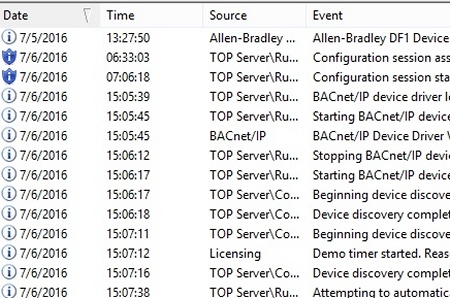
In this blog, we will cover the built-in startup and testing features included in the TOP Server including a video link to see these tools in action.

These tools include a sample OPC client that can help with quickly testing connectivity to your devices, as well as device-to-server level and server-to-client level communication diagnostics. The user interface displays important informational messages, as well as communication warnings and errors. Also available is extensive and easy to navigate help documentation.

We’ll briefly discuss each of these tools and take a look at a video which walks us through the use of each of these tools and points us to further troubleshooting resources at Software Toolbox.

Continue Reading

Protocol Docs - The Good, the Bad, the Ugly

4 min read

By Kevin Rutherford on May 31, 2016 2:00:00 PM


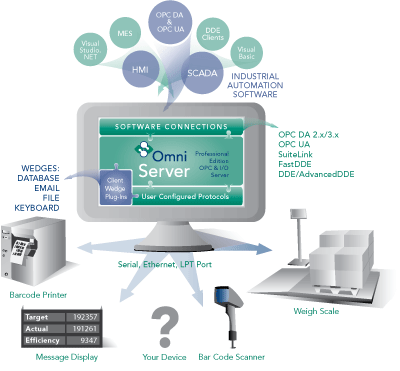
If you’re reading this blog, you likely need a way to collect data from some random device in your process – something like a barcode reader or a weigh scale or an RFID system or some other device.  These are the types of device that don’t typically yield favorable results when you type “OPC Server for xyz” into a Google search.

In this blog post, I'll discuss the device manufacturer documentation that is typically provided for such devices and what some of the key information is you'll be looking for - including examples of how a good protocol document will present such information.

Continue Reading

Performance matters when choosing a tunneler

2 min read

By Win Worrall on Apr 26, 2016 2:00:00 PM


This is Part 4 of our “25 Things to Consider when Choosing an OPC Tunnel” series. Performance matters when choosing a tunneler.

Performance is always an important consideration when choosing the best tunneler.  It is even more important if one or more of the following is true:

  • You need to transfer a lot of data very fast.
  • You are using networks with limited bandwidth.
  • You are using cellular or satellite networks that charge based on the amount of data used.

This blog post will cover some important aspects to consider when evaluating different tunneling solutions, their methods and the resulting performance relative to such variables.

Continue Reading

How should a tunneler handle network security?

2 min read

By Win Worrall on Apr 5, 2016 1:14:18 PM


This is Part 2 of our “25 Things to Consider when Choosing an OPC Tunnel” series. How does the tunneler handle security?

Security is an integral consideration when choosing a tunneling solution.  This blog will cover some important aspects of security to consider when evaluating different tunneling solutions.

Continue Reading

How should a tunneler respond when the network connection is lost?

3 min read

By Win Worrall on Mar 23, 2016 12:59:12 PM


This is Part 1 of our “25 Things to Consider when Choosing an OPC Tunnel” series. When choosing software applications to handle the tunneling of your data, there is more to making the right choice than simply a checkbox on a product datasheet that says “tunneling”. This series will introduce you to the considerations that will help you make an informed choice and choose the most effective tunneler for your specific application requirements. If you are unfamiliar with what an OPC tunnel is, please read our post “ Tunneling OPC Data – What Is It?
Continue Reading

Connect Your HMI/SCADA to Barcode Scanners

5 min read

By Kevin Rutherford on Jan 28, 2016 1:59:16 PM

Barcode scanners are one of those types of devices that are extremely common in a variety of industries, whether it's for use in a manufacturing process or for cataloging inventory or a multitude of other possible uses.  But how do you go from scanning a barcode to making that barcode data available to your monitoring applications such as an HMI or a SCADA?

Over the years of working in the automation software realm, I've seen dozens of clients have this seemingly basic need to bring barcodes up into various software packages.  Regardless of the make/model of the scanner, the process is almost identical.  For example, you could connect to a DataLogic scanner in under five minutes. (Click for How-To Video)

This post will cover the steps for bridging that gap between your scanners and your client applications.

Continue Reading

3 Considerations for Maximizing Uptime over Serial Radio Networks

2 min read

By Kevin Rutherford on Dec 8, 2015 4:26:17 PM


With the majority of companies in the oil, gas, railroad, water, wastewater, mining and power/utilities industries requiring wide area distributed radio networks for communications, engineers in charge of these radio networks have the daunting task of maintaining the highest level of performance and uptime at all times.

Given that you're reading this, I will choose to make the assumption that you are either an engineer in charge of such a radio network or that you've had some interaction on some level with such a radio network and it may not have been an altogether pleasant experience.

We're going to discuss a few things to keep in mind if you're interested in getting the most uptime possible out of your serial radios (and, let's face it, why wouldn't you want that).

Continue Reading

About this Blog

We're engineers like you, so this blog focuses on "How to" appnotes, videos, tech team tips, product update announcements, user case studies, and other technical updates.  Subscribe to updates below. Your feedback and questions on posts are always welcomed.

Subscribe to our Blog

Recent Posts

Posts by Topic

See all