
Software Toolbox Technical Blog

Video How-To: Connect Non OPC-UA Clients to UA Servers with TOP Server

2 min read

By Kevin Rutherford on Aug 27, 2020 2:00:00 PM


While TOP Server for AVEVA™, formerly Wonderware provides connectivity to hundreds of device types and protocols, that is only part of how TOP Server helps with integrating industrial process data with external software such as AVEVA™ System Platform, formerly Wonderware and other client applications.

You're likely aware that TOP Server is an OPC UA server.  But TOP Server can also act as an OPC UA client for integrating with other OPC UA servers, as well.  For situations where you have a UA server to integrate but your client does not support OPC UA, but does support one of TOP Server's other client interfaces, TOP Server can be the gateway solution. This is especially valuable for AVEVA users who wish to keep using AVEVA Suitelink, OPC DA, or have not migrated to a version of AVEVA applications that support OPC UA Client functionality. 

In this video blog, I'll show you how to make a secure OPC UA connection from TOP Server to other OPC UA servers supporting the Data Access profile.  We cover the basics of configuring the OPC UA Client driver in TOP Server and making an OPC UA connection to another OPC UA server.

Continue Reading

Converting an OPC DA Server to OPC UA with DataHub OPC Gateway

2 min read

By Win Worrall on Aug 20, 2020 2:00:00 PM


Cogent DataHub enables a wide range of flexible connectivity options between interfaces for different data sources such as OPC UA, MQTT, OPC DA, ODBC, DDE and so much more.  This is why we commonly refer to DataHub as a "gateway", as it is frequently utilized for data integration by external software such as HMI, SCADA, MES, historians and other client applications, including for IIoT integration.

In Part 1 of our Cogent DataHub Virtual Training series, we will cover step-by-step how to easily connect OPC UA (Data Access Profile) client applications to your OPC DA Classic server data sources.

Continue Reading

How to Develop Custom OPC Clients with Minimal Code

3 min read

By Ganesh Kalipershad on Aug 13, 2020 2:00:00 PM

As we discussed in the first post of this series, the term "OPC client" often refers to off-the-shelf HMI or SCADA applications.  OPC clients can also be other custom developed software applications in your enterprise that could benefit from access to OPC process data.  Or there might be a new custom application you need to develop that requires access to OPC process data.  In those situations, you need a reliable, straightforward method to enable those applications as OPC clients.

In Part 2 of our series on How to Develop Custom OPC Clients, we will cover step-by-step how to use low-code techniques to read, write and subscribe to OPC process data through building a basic OPC client application in Visual Studio.NET.
Continue Reading

Top 4 Benefits of Using a Hardware Key with OmniServer

5 min read

By Kevin Rutherford on Aug 6, 2020 2:00:00 PM


Software-based licensing is a commonality among software solutions across all industries, not just industrial process control.  It's flexible, doesn't require physical shipping and is very reliable. But some system architectures can ultimately benefit from another licensing option - hardware keys.

Hardware key licensing is invaluable for high-availability systems for a number of reasons.  We've recently expanded licensing support in OmniServer, the proven OPC solution for integrating non-standard devices that don't have an off-the-shelf driver, to include optional hardware key support.

In this blog post, we'll cover the key reasons that hardware key licensing is beneficial for many OmniServer users.

Continue Reading

How to Develop Custom OPC Clients with No Code

2 min read

By Ganesh Kalipershad on Jul 30, 2020 2:00:00 PM

When you hear the term "OPC client", you may initially think of off-the-shelf HMI or SCADA applications.  However, it's common in enterprises across most industries for there to be other custom developed software applications that could benefit from access to OPC process data.  Or perhaps there is a new custom application you're working on that needs to access OPC process data.  The question, then, is how to enable those applications as OPC clients.

In Part 1 of our series on How to Develop Custom OPC Clients, we will cover step-by-step how to use no-code techniques to bind production data to various types of user interface elements for reading, or writing, or both to build a basic OPC client application in Visual Studio.NET.
Continue Reading

OPC Router Basic Training - Writing SQL Data to OPC Servers

2 min read

By Marc Holbach on Jul 23, 2020 1:45:00 PM

As we discussed in Part 1 of our OPC Router Basic Training series, it is quite common for process industry projects to require logging of industrial process data to a database such as Microsoft SQL.  On the other side of the coin, it is also quite common for information such as recipes or other data to be stored in a database such as SQL and to then need to push that data down to process devices.

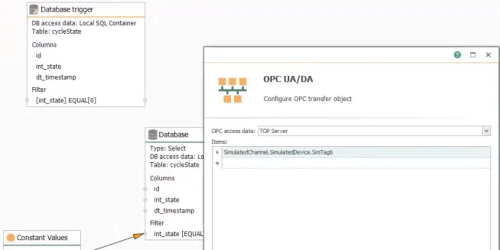
In Part 2 of the series, we will cover step-by-step how to write stored SQL data to OPC UA and DA servers based on flexible scripted trigger conditions with the OPC Router.

Continue Reading

OPC Router Basic Training - Connecting SQL to OPC Data Sources

2 min read

By Marc Holbach on Jul 9, 2020 2:00:00 PM

Logging industrial process data to a database such as Microsoft SQL is a common requirement of many projects across industries.  One of the key applications for storing industrial process data is providing historical context and reporting of the process so that better decisions can be made.

In Part 1 of our OPC Router Basic Training series, we will cover step-by-step how to easily connect to OPC UA and DA data sources to SQL databases for logging process data with the OPC Router.

Continue Reading

Why use an OPC Server Development Toolkit?

8 min read

By Ganesh Kalipershad on Jun 25, 2020 2:00:00 PM


As technical consultants at Software Toolbox, we are often approached by users who need to expose data from a software application they have written, or are writing, to communicate from systems they own to a client, HMI/SCADA, or historian. And, in many cases, there are dozens of applications at different sites that the data needs to reach. The question we are then presented with is, “how can I accomplish this quickly and efficiently while staying within budget?” 

Continuing our OPC Development Toolkits blog series, our hope is to answer this question and share from our experience with OPC since 1996, what our users have told us are the common reasons why they chose to use a commercial OPC server toolkit, and to help readers determine what factors to consider for their specific situation and circumstances.

In the first part of this series, we covered the basics of commercial OPC client development toolkits, with a dive into the benefits of using one, while here in part 2, our focus is on OPC server development toolkits. If you read our blog on OPC client toolkits, you will likely notice a clear overlap in the benefits you gain from using both types of commercial OPC toolkits.

Continue Reading

About this Blog

We're engineers like you, so this blog focuses on "How to" appnotes, videos, tech team tips, product update announcements, user case studies, and other technical updates.  Subscribe to updates below. Your feedback and questions on posts are always welcomed.

Subscribe to our Blog

Recent Posts

Posts by Topic

See all